

Public confidence in political leaders plummets as pub closures soar
Soaring energy costs and lack of business support from the government have resulted in an increase in pubs forced to declare last orders as the backbone of the British culture is being threatened.
There is a significant lack of faith in political leaders to protect from closures as nearly half of the population doesn鈥檛 believe any political party has the pub鈥檚 best interests at heart.
The survey conducted by Campaign for Real Ale (CAMRA) revealed the sobering statistics that 43% of those surveyed don鈥檛 trust political leaders to protect pubs, whereas, Kier Starmer fared the best after he garnered the trust of 17% of respondents.
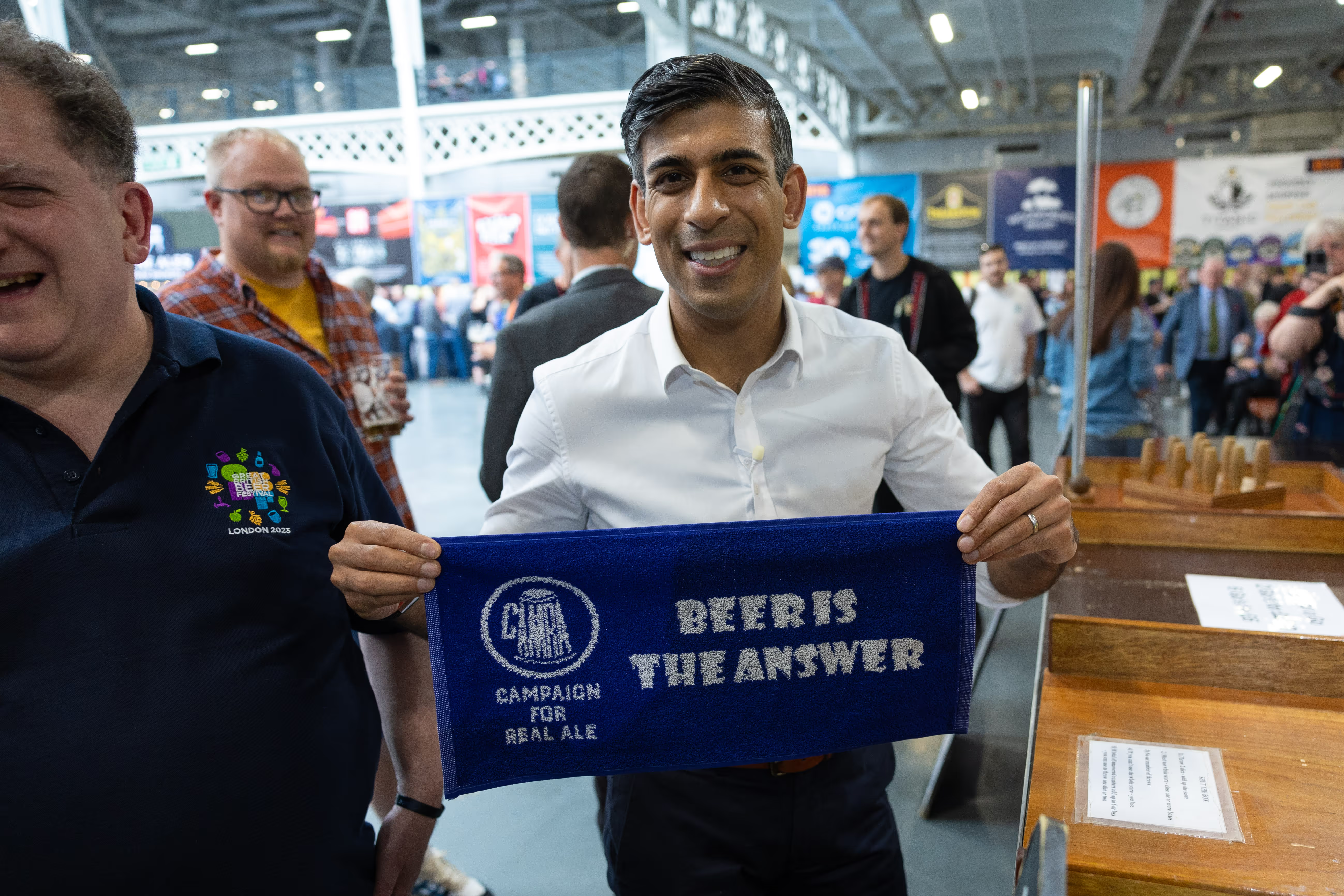
Conservative leader Rishi Sunak had the support of 9% despite the support that hospitality owners received during the pandemic, which saw furloughed staff and business grants issued to ensure that businesses struggling through the pandemic would keep afloat.
But a similar level of monetary intervention is yet to be seen to tackle stubbornly high business rates and relentless energy increases.
As local boozers are closing around us, the pressures for the hospitality sector to survive are constantly looming.
These factors have seen pub closures reach the highest quarterly figure since the 2008 recession in the second quarter of the year.
Data obtained from the Morning Advertiser highlighted that 223 pubs shut their doors in Q2, which overshadowed the already concerning 200 closures in Q1, marking the highest figure in over a decade.
However, the bleak reading may be remedied with the fact that this figure hasn鈥檛 hit the unprecedented levels of the 2008 recession, where the British Beer and Pub Association (BBPA) highlighted that there were 1973 and 38 closures per week across the UK. In conjunction with this, the past 12 months have experienced 729 pub businesses going bust, which is a stark rise of 80% from 2021/2022, which transpires to 14 closures a week, which is still a sobering reminder that our pubs are in dire straits.
精东传媒 spoke to the co-founder of Spice Consultancy, Ed Spice, who has been a permanent figure within the hospitality scene after owning multiple pubs for 20 years and currently runs Tap @ The Shed in Bordon.
Spice Consultancy ensures that pubs survive and thrive by directly working with people who have just taken on pubs to ensure that they鈥檙e making the right decision when opening.
Speaking about the data, Spice said: 鈥淭he numbers are huge, it's because of electricity, gas and staff shortages, and quite frankly a lot of landlords getting burned out and are deciding to leave the industry as well.
鈥淚t鈥檚 a very complicated industry.
鈥淭here are so many different sectors that make up the pub industry from Pubco-owned tenanted and leasehold pubs to privately owned freeholds and freeholds rented out by private owners.
鈥淢ost pubs outside of town and city centres really have to focus on food trade to survive. 鈥淭o have good food you have to have a great team delivering consistency, it doesn't have to be gastro food, but it's got to be consistent.
鈥淭here are huge staff shortages in the kitchen sector at the moment.
鈥淩ight now you have to think very carefully about entering into a new pub, as there are so many closing and the industry is going through another contraction.
鈥淭here will be permanent closures but it's a question of which ones are the right ones to close and are really unviable to operate.
鈥淭hen there are pubs that people are just trying to profiteer from shutting - and those people really upset me.鈥�
Spice continued to share what the government can do to instill more public confidence, saying: 鈥淚t's a hard one in terms of support because let's say the government supports everyone's electricity prices, the guys who are doing well will still do well and earn money and the guys who are on the precipice of going bust; well you're just holding off the inevitable.
鈥淲hen they reduce beer tax or hold it; that's at the brewery level, this effect then has to filter through the system to the end punter and quite often it helps, but prices still rise through other issues such as the inflation we have seen on ingredients.
鈥淚n 2008, I tried to lead an initiative to up tax on supermarket alcohol and reduce tax on the hospitality sector where I ended up speaking with Jeremy Hunt 鈥� the then Culture Secretary.
鈥淭o be honest the meeting felt like a ticked-box exercise and nothing came of it. 鈥淧ubs used to be the heart of the community with young and old socialising together, but today many just stay at home and drink cheap supermarket booze and the heart and culture of the pub is failing.
鈥淲hen you drink in a pub you are actually being monitored and controlled, not only by the landlord and staff but by the other users.
鈥淚t is a far safer place to enjoy a drink.
鈥淭hese days many people pre-load before heading out and that is where much of the trouble stems from.
鈥淪o often these days, the pub industry gets the blame for the anti-social behaviour that happens in our towns and cities.
鈥淭he truth however is that many people are descending on pubs and nightclubs already sloshed, spending very little when they are out, yet enjoying all the entertainment being put on for them.
鈥淭his is another part of why most operators have pushed catering.
鈥淏ut how can a government prop up such a huge industry?
鈥淚t is a complicated topic and one I think the government don鈥檛 understand and seems to be relatively disinterested, which is a real surprise as the amount of tax and employment the hospitality sector raises is huge.
鈥淓very adult in the country thinks they could run a pub but I have to caution that if you enter the industry with no qualifications or experience the likeliness is you will lose a lot of money. 鈥淭hat's why I offer a 30-minute free discussion just to check firstly that you鈥檙e completely invested as this is a very dangerous business to start.鈥�
The last time closures hit this level was in 2008, with varying factors such as the raised alcohol duty by six per cent in real terms was introduced at a time when supermarkets have tried to entice shoppers in with discounts on booze.
Alongside the smoking ban in 2007, the number of punters heading to their local shindigs significantly declined.
To fight the recession, the government implemented a small business loan to underwrite 80% of business loans to provide protection and a temporary tax cut to stimulate spending for those businesses.
Breaking down some of the obstacles the consultancy owner has recently experienced first-hand, following the exceptionally high insolvencies, Spice said: 鈥淲e've had huge energy problems as a whole country, and the businesses were supported initially, but there hasn't been a business cap on energy.
"Recruitment is now impossible, which has meant a huge amount of landlords have retrained themselves to cook because they can't get anyone in the kitchens.
鈥淚 think we need to be encouraging Visa schemes to try and get people back into the industry because the lack of staff has meant that we're all now paying a lot more than we were for our staff, so staffing costs have gone through the roof.
鈥淓verything is running on a shoestring.
鈥淭he one thing that I think is important to mention is that the government propped the whole industry up through COVID incredibly, and from my perspective, it did an amazing job of supporting the industry.
鈥淲hen we came out of COVID, there weren't loads of closures as we thought there was going to be, and I'm sure there are a lot of people out there who would disagree with me saying that but credit where credit is due.鈥�
The situation surrounding pub closures may get worse before it gets better without some form of intervention or give on the current landscape of inflation, and there is a grim possibility that the number of insolvencies will continue to increase threatening the heartbeat of the local community.
鈥�
Related news

.jpg)
